Executive summary
Modern organizations increasingly depend on communications infrastructure they do not own and cannot fully trust. Mission-critical communications routinely traverse the public Internet, commercial cellular networks, Wi-Fi, satellite, Starlink, tactical radios, partner networks, cloud infrastructure, and other third-party systems.
At the same time, the cyber threat is changing. Artificial Intelligence can increasingly automate reconnaissance, vulnerability discovery, scanning, credential attacks, exploitation, and lateral movement. Future quantum computing creates an additional threat to traditional public-key cryptography.
NetTron™ addresses these problems architecturally. NetTron™ is a software-defined secure networking platform that creates a hardware-anchored secure overlay connecting explicitly authorized Red Zones across virtually any available communications bearer.
GuardTron™ and other NetTron™-compatible edge nodes establish hardware security boundaries around protected users, devices, applications, networks, facilities, vehicles, unmanned systems, and other assets. Between those boundaries, NetTron™ creates authenticated, encrypted, segmented, policy-controlled communications paths. Above the distributed network, the NetTron™ Command & Control Console (CCC) provides centralized visibility, policy, identity, configuration, monitoring, and management of the NetTron™ fabric.
The architecture therefore separates three functions:
- Edge security — GuardTron™ and other edge nodes establish the hardware-anchored Red Zone boundaries.
- Secure communications — NetTron™ creates the authenticated and encrypted overlay connecting authorized Red Zones.
- Command & control — CCC provides centralized software-defined control and visibility across the distributed NetTron™ environment.
The underlying network becomes transport—not trust. Internet, satellite, Starlink, Wi-Fi, LTE/5G, tactical radio, P2P, commercial networks, and other bearers can transport NetTron™ communications without becoming part of the trusted environment.
This creates complementary layers of protection:
- Reduce the attack surface — Hardware-anchored Red Zones isolate protected environments from unnecessary exposure to underlying networks.
- Reject unauthorized communications — Only explicitly authorized NetTron™ destinations and applications are permitted to communicate.
- Protect authorized communications — Post-quantum cryptography protects authorized communications against current and emerging cryptographic threats.
- Centrally control the fabric — CCC allows authorized administrators to manage identities, nodes, policies, topology, security, and operations across the NetTron™ network.
- Monitor and respond — Telemetry, analytics, monitoring, and AI capabilities provide visibility into the operation and security of the protected environment.
The resulting security principle is simple: do not expose everything and then attempt to identify every attacker. Reduce what is exposed, explicitly define what may be communicated, centrally control the environment, and reject everything else.
1. The problem
Today's Networks Expose Too Much
Traditional network architectures were developed around connectivity. Users and systems connect through networks containing enormous numbers of devices, addresses, applications, interfaces, services, and potential destinations.
Cybersecurity is then layered onto this environment to determine:
- Who is legitimate?
- Which devices are trusted?
- Which traffic is malicious?
- Which vulnerabilities are exploitable?
- Which destinations should be blocked?
- Has an endpoint already been compromised?
This creates a continuously expanding attack surface. Every exposed interface, reachable service, network path, credential, protocol, device, and application can potentially become another opportunity for an attacker.
AI changes the economics of attack
Historically, discovering and exploiting those opportunities required significant human expertise and time. AI increasingly changes that equation. AI-enabled offensive capabilities can accelerate:
- Network reconnaissance
- Vulnerability discovery
- Attack-surface mapping
- Credential attacks
- Exploit development
- Malware adaptation
- Lateral movement
- Command-and-control activity
- Data discovery
- Data exfiltration
The problem is therefore no longer simply: “Can we detect attacks faster?”
A more fundamental question is: “How much attack surface should we expose in the first place?”
NetTron is designed around that question.
2. The NetTron architecture
Extend the Red Zone — Not Trust in the Network
A Red Zone is a protected environment containing authorized users, devices, applications, information, or operational systems. NetTron™ connects these Red Zones through a hardware-anchored secure network overlay.
The networks between NetTron™ boundaries provide transportation. They do not define trust. This allows NetTron™ to extend trusted communications across infrastructure that may itself be public, commercial, shared, contested, or otherwise untrusted.
3. The NetTron™ secure tunnel
Make Distant Red Zones Behave Like One Protected Environment
The NetTron™ architecture creates a secure tunnel between authorized Red Zones.
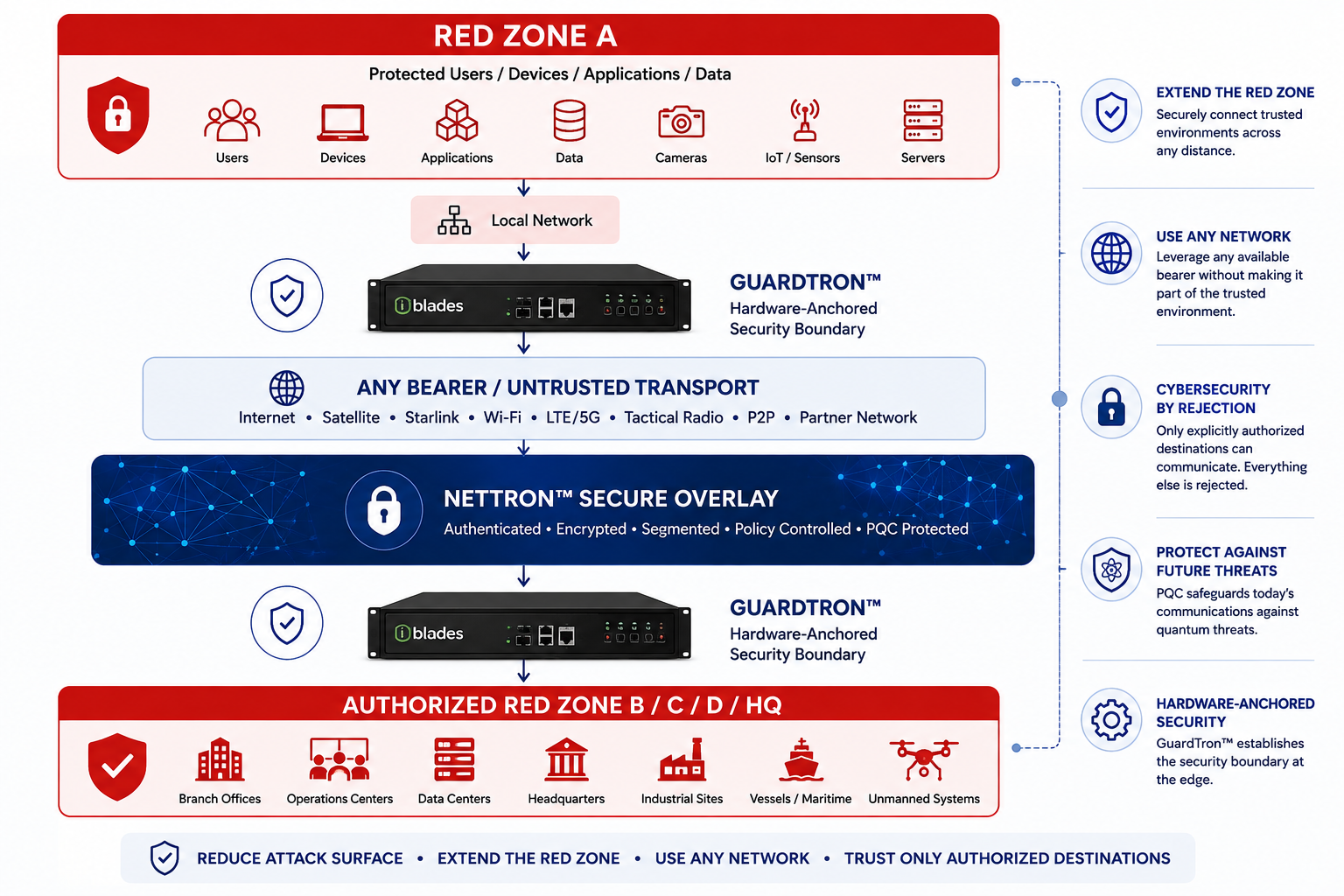
From the perspective of protected systems, authorized Red Zones communicate through an authenticated, encrypted, controlled NetTron™ environment even though the physical path may traverse infrastructure neither party owns nor trusts.
For example:
- HQ → Internet → Remote Facility
- Command Center → SATCOM → UAV
- HQ → Starlink → USV
- Bank Data Center → Internet → Branch
- Airline Engineering → Airport Network → Maintenance Team
- Embassy → Commercial ISP → Government Headquarters
The bearer can change. The NetTron™ security model does not.
THE BEARER PROVIDES CONNECTIVITY.
NETTRON™ PROVIDES THE TRUSTED COMMUNICATIONS ENVIRONMENT.
4. NetTron™ Command & Control Console (CCC)
One Software-Defined Control Plane for the Entire Secure Network
The secure tunnels and hardware boundaries form the distributed NetTron™ communications fabric. The NetTron™ Command & Control Console (CCC) provides the centralized software management and control plane above that fabric.
CCC gives authorized administrators a unified environment for managing NetTron™ nodes, identities, communications policies, network relationships, security status, and operational visibility.
This is an important distinction: NetTron™ is not simply a collection of security appliances. It is a centrally managed, software-defined secure networking platform extending across distributed hardware nodes.
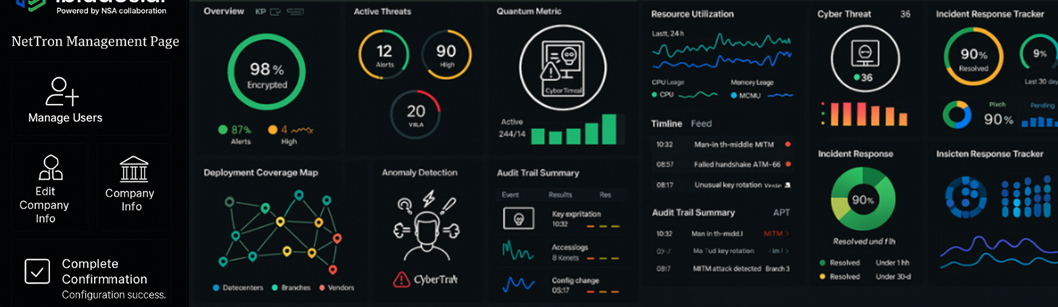
Centralized control — distributed enforcement
CCC can centrally define the network. NetTron™ edge nodes enforce those policies at the distributed hardware boundaries. Conceptually:
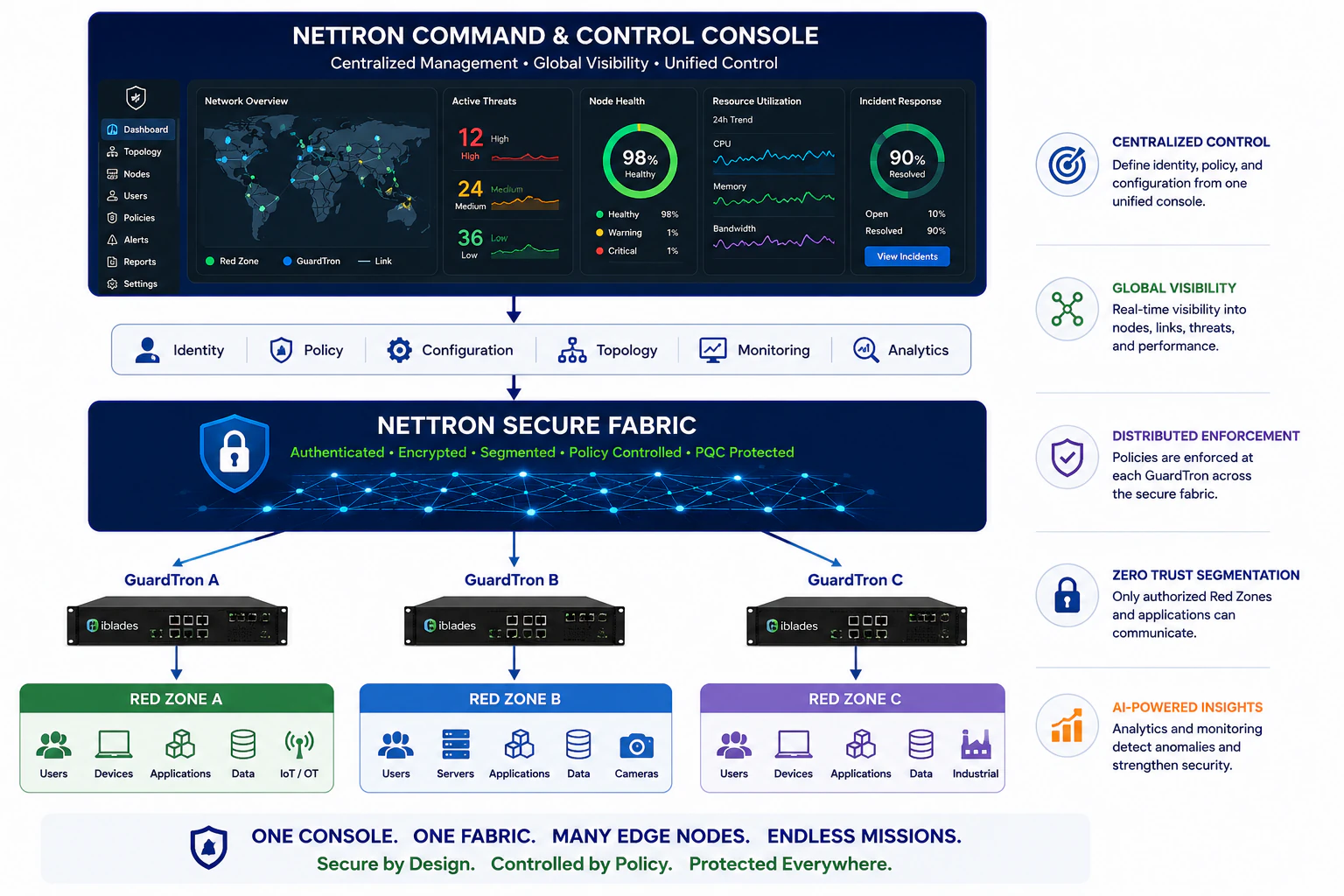
This enables centralized administration without requiring the security enforcement itself to reside at a single central location.
What CCC controls
Depending upon deployment configuration, CCC provides centralized capabilities for:
- Node management — add and manage NetTron nodes, provision distributed edge systems, maintain node identity, monitor node availability and health, manage network configuration.
- Identity & authorization — define authorized users, define authorized devices and nodes, establish trusted relationships, control which Red Zones may communicate, revoke authorization when required.
- Network topology — visibility into Red Zones, GuardTron™ and other edge nodes, authorized connections, deployment locations, network relationships, and operational status.
- Policy management — centrally establish communications policies determining who can communicate, what can communicate, which Red Zones can communicate, which applications are permitted, and which paths and relationships are authorized. The policies are then enforced at the distributed NetTron™ boundaries.
- Security monitoring — visibility into network activity, authentication events, node status, policy enforcement, communications behavior, operational anomalies, threat indicators, and system health.
- Audit & event history — centralized event and audit information provides administrators with visibility into security and configuration activity across the NetTron environment.
5. Hardware agnostic at the network level
One NetTron Fabric — Multiple Edge Forms
GuardTron is an important NetTron hardware implementation, but the NetTron architecture is larger than any individual appliance. Different missions require different size, weight, power, interfaces, throughput, environmental characteristics, and form factors.
The NetTron software-defined architecture can therefore support different compatible edge-node implementations while maintaining a common security and management model. For example:
- GuardTron™ — fixed infrastructure, facilities, vehicles, vessels, tactical systems, data centers, and other network environments.
- ManoTron™ — mobile and individual-user applications.
- Embedded / SWaP-optimized NetTron edge nodes — future or mission-specific implementations for unmanned systems, sensors, radios, aircraft, robotics, and other size-, weight-, and power-constrained platforms.
All can participate in one NetTron secure fabric and be centrally controlled through one NetTron Command & Control environment.
This makes NetTron fundamentally a software-defined secure networking architecture with hardware-anchored enforcement at the edge.
6. Reducing the attack surface
What an Attacker Cannot Reach Is Harder to Attack
One of the most important consequences of the NetTron architecture is reduction of unnecessary network exposure. Traditional connected systems frequently expose devices and services directly or indirectly to large network environments. That creates opportunities for:
- Network scanning
- Port discovery
- Service enumeration
- Remote probing
- Credential attacks
- Exploitation of exposed services
- Lateral movement
- Unauthorized inbound communications
- Unauthorized outbound communications
- Command-and-control traffic
- Data exfiltration
NetTron changes the topology. Protected Red Zones sit behind hardware-anchored boundaries and communicate through explicitly authorized NetTron paths.
The objective is not simply to encrypt an exposed system.
THE OBJECTIVE IS TO EXPOSE LESS OF THE PROTECTED ENVIRONMENT IN THE FIRST PLACE.
Traditional connected architecture (large potential attack surface)
Protected Device ↔ Network / Internet ↔ Potentially enormous numbers of reachable systems, services, destinations, and attackers
NetTron architecture (reduced exposed attack surface)
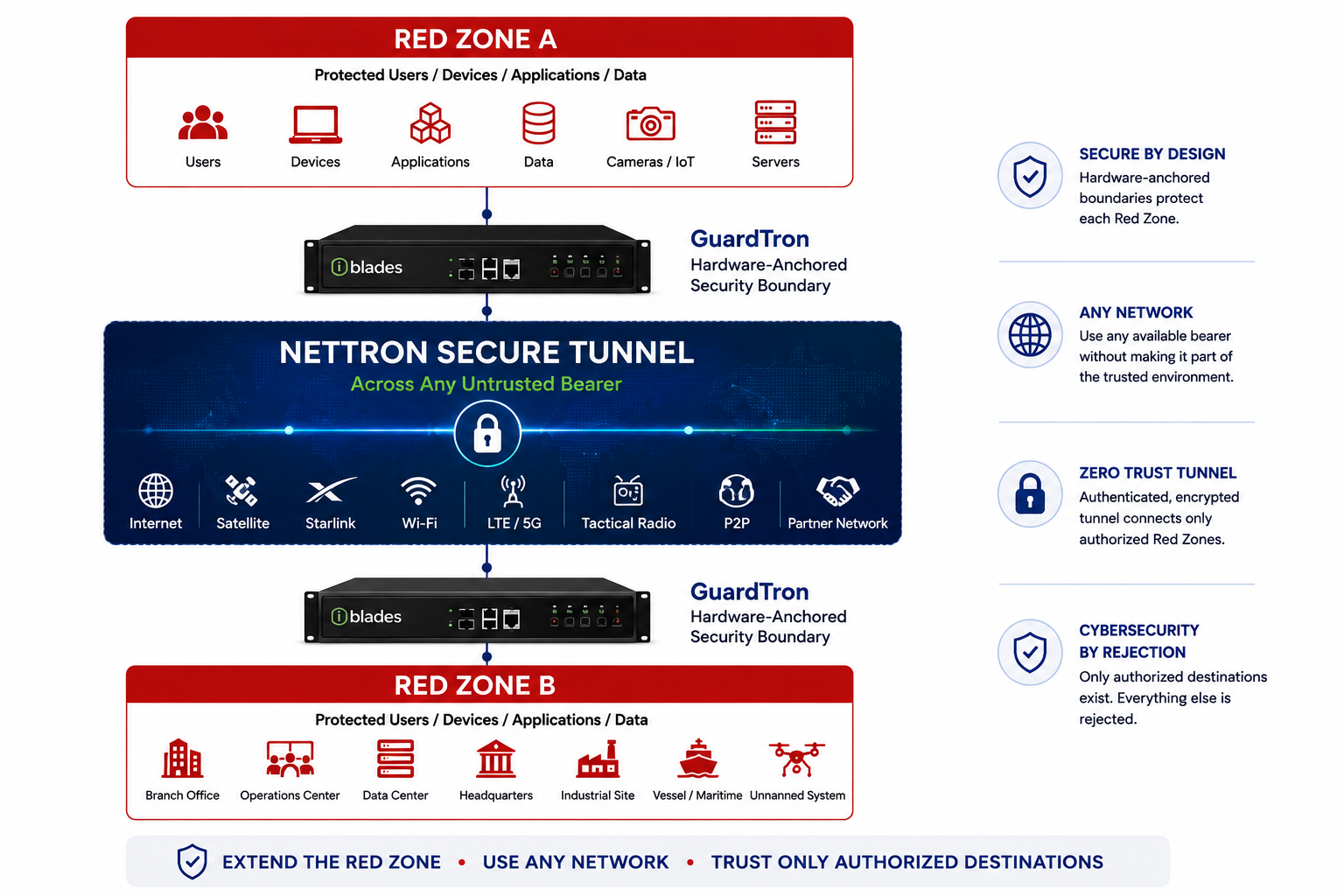
Protected Red Zone ↔ GuardTron ↔ Authorized NetTron Communications Fabric ↔ GuardTron ↔ Authorized Red Zone
This becomes increasingly important as AI enables attackers to search large attack surfaces at machine speed.
7. AI-threat resilience by architecture
AI can dramatically improve an attacker's ability to search for weaknesses. But AI cannot exploit a communications path that the architecture does not permit.
This creates an important distinction between:
- Detecting AI-driven attacks
- Reducing the environment available for AI to attack
NetTron is designed to address both. Its hardware-anchored overlay reduces unnecessary network exposure. Cybersecurity by Rejection restricts communications to explicitly authorized destinations. CCC provides centralized visibility into the environment. Monitoring and AI capabilities can then analyze activity occurring within the permitted network.
The resulting model is:
- Reduce — reduce exposed attack surface
- Reject — reject unauthorized communications
- Protect — PQC-protect authorized communications
- Control — centrally define identities, policies, and network relationships
- Monitor — observe the distributed environment
- Detect — apply AI and analytics to identify anomalies and threats
Instead of asking AI to defend an unlimited number of possible network interactions, NetTron first constrains the environment that needs to be defended.
8. Cybersecurity by rejection
Define What Is Allowed Instead of Discovering Everything That Is Bad
Traditional cybersecurity frequently operates by identifying threats inside a highly connected environment. NetTron™ reverses that model.
Within the protected NetTron™ communications fabric:
- Authorized destinations are explicitly established.
- Communications are permitted between authorized Red Zones and applications according to NetTron policy.
- Everything else is rejected.
Instead of continually asking: “Is this destination malicious?”
NetTron™ first asks: “Is this an authorized NetTron™ destination?”
If the answer is no, there is no permitted NetTron™ communications path to that destination.
Even if an endpoint is compromised
Consider malware operating on a device inside a protected Red Zone. The malware may attempt to:
- Ping an external address
- Scan external networks
- Contact command-and-control infrastructure
- Beacon to a remote server
- Send stolen credentials
- Upload files
- Exfiltrate telemetry or operational data
Where the device's communications are constrained through the NetTron boundary, the malware does not gain an authorized destination merely because it originated from a trusted device.
THE ENDPOINT MAY BE COMPROMISED.
THE DESTINATION STILL HAS TO BE AUTHORIZED.
9. Containing data exfiltration
Many cyberattacks are only useful if information can ultimately leave the protected environment. A compromised system may successfully collect sensitive information—but it still requires a communications path to move that information to the attacker.
NetTron™ constrains those paths. If an external IP address, server, cloud service, application, or network is not an authorized NetTron destination, the protected communications fabric does not provide a permitted path to it.
NetTron therefore does not have to identify every malicious destination on Earth. Instead:
NETTRON™ DEFINES THE DESTINATIONS THAT ARE SUPPOSED TO EXIST.
Everything else is rejected by design.
10. Any bearer: transport without trust
NetTron™ is designed to operate across heterogeneous communications infrastructure.
| Bearer | Role in NetTron |
|---|---|
| Internet | Transport |
| Ethernet | Transport |
| Wi-Fi | Transport |
| LTE / 5G | Transport |
| Satellite | Transport |
| Starlink | Transport |
| Tactical Radio | Transport |
| P2P Links | Transport |
| Partner Networks | Transport |
| Commercial Carrier Networks | Transport |
| Cloud Connectivity | Transport |
The security model remains above the bearer. Organizations can therefore select connectivity based upon availability, coverage, bandwidth, mission, geography, cost, and resilience without making the transport network itself the trusted security boundary.
11. Post-quantum security
Reduce the Attack Surface — Then Protect the Communications That Remain
Reducing attack surface and rejecting unauthorized communications do not eliminate the need for strong cryptography. Authorized communications must still be protected.
Quantum computing creates a future threat to many traditional public-key cryptographic systems and creates today's Harvest Now, Decrypt Later risk. NetTron incorporates post-quantum cryptographic algorithms into its secure communications architecture.
PQC can protect:
- Key establishment
- Authentication
- Digital signatures
- Secure communications
- Credential management
The complete model becomes:
- Reduce exposure — hardware-anchored Red Zones reduce unnecessary attack surface.
- Reject unauthorized paths — Cybersecurity by Rejection restricts communications to explicitly authorized destinations.
- Protect authorized traffic — post-quantum cryptography protects permitted communications.
12. Autonomous key & credential management
Strong cryptography becomes operationally difficult if every credential and key requires manual administration. Large distributed environments may contain thousands of users, devices, facilities, vehicles, sensors, radios, and autonomous platforms.
NetTron™ is designed to automate credential and key-management functions, including generation, exchange, management, rotation, and revocation. CCC provides centralized administrative visibility and control while NetTron automates appropriate operations across the distributed fabric.
ADVANCED CYBERSECURITY SHOULD BECOME EASIER TO OPERATE — NOT HARDER.
13. Segmentation by design
Not every Red Zone should communicate with every other Red Zone. CCC and NetTron policy can explicitly define authorized relationships. For example:
Aviation
Maintenance Team → Engineering → Maintenance Records → Authorized MRO
but not necessarily:
→ Finance → Arbitrary Internet Destinations → Unrelated Corporate Systems
Unmanned systems
USV 1 → USV 2 → Command & Control
but not:
→ Arbitrary Internet Destinations
This creates secure micro-segmented communications environments according to mission and operational requirements.
14. Legacy systems — modern security
Replacing every endpoint is rarely practical. Mission-critical organizations frequently operate equipment with useful lives measured in decades. NetTron enables another modernization strategy:
KEEP THE OPERATIONAL SYSTEM.
MODERNIZE THE SECURITY ARCHITECTURE AROUND IT.
By establishing hardware-anchored boundaries around existing environments, NetTron can integrate legacy assets into a modern secure communications fabric. This reduces infrastructure replacement, integration complexity, deployment time, capital expense, and operational disruption.
15. Plug-and-play, autonomous security
Advanced cybersecurity cannot scale if every deployment requires a team of specialized engineers. NetTron™ is designed to minimize deployment and management overhead through:
- Preconfigured deployment profiles
- Automated node configuration
- Autonomous credential management
- Autonomous key rotation
- Centralized CCC management
- Distributed policy enforcement
- Remote monitoring
- Scalable node deployment
The objective is to combine centralized command & control with distributed autonomous security. This allows a small central team to manage a potentially large distributed NetTron environment.
16. The NetTron security model
NetTron can be summarized through seven architectural principles.
| Principle | NetTron approach |
|---|---|
| Reduce | Reduce unnecessary network exposure and attack surface |
| Reject | Permit only explicitly authorized destinations and communications |
| Isolate | Hardware-anchor protected Red Zones behind secure edge boundaries |
| Protect | Apply post-quantum cryptography to authorized communications |
| Control | Centrally define identities, policies, topology, and relationships through CCC |
| Monitor | Observe network, node, policy, and security activity |
| Automate | Automate credentials, keys, configuration, and management wherever possible |
REDUCE → REJECT → ISOLATE → PROTECT → CONTROL → MONITOR → AUTOMATE
17. NetTron at a glance
| Traditional cyber challenge | NetTron architectural response |
|---|---|
| Large exposed attack surface | Hardware-anchored overlay reduces unnecessary exposure |
| AI-accelerated reconnaissance | Reduce systems and paths available for discovery and attack |
| Unknown external destinations | Only explicitly authorized NetTron destinations are permitted |
| Data exfiltration | Unauthorized external destinations have no permitted NetTron path |
| Compromised endpoint | Endpoint does not automatically gain unrestricted external communications |
| Lateral movement | Red Zones are segmented according to explicitly authorized relationships |
| Distributed nodes | CCC provides centralized visibility and control |
| Mixed hardware requirements | Common NetTron software fabric can support different edge-node form factors |
| Untrusted Internet / networks | Treat them as transport—not trust |
| Quantum threat | PQC protects authorized communications |
| Manual key management | Autonomous credential and key management |
| Legacy equipment | Place the modern security boundary around existing assets |
| Multiple bearers | Use Internet, LTE/5G, Wi-Fi, satellite, P2P and other transport |
| Remote/mobile operations | Extend hardware-anchored Red Zones to field assets |
| Cybersecurity staffing burden | Centralized CCC plus plug-and-play distributed deployment |
| Evolving threats | Architectural protection combined with monitoring and AI |
18. One platform — many missions
The underlying challenge is common across industries: how do trusted assets communicate securely across infrastructure that cannot itself be trusted?
- Defense & Intelligence — HQ • Tactical Users • Radios • Vehicles • Sensors • Unmanned Systems • Remote Sites
- Unmanned Systems — UAV • USV • UGV • Cameras • Sensors • Telemetry • C2
- Aviation — Aircraft • Maintenance Teams • Engineering • MRO • Operations • Maintenance Records
- Financial Services — Data Centers • Branches • ATMs • Payments • Mobile Operations • Cloud
- Government — Ministries • Agencies • Embassies • Mobile Personnel • Critical Infrastructure
- Critical Infrastructure — Control Centers • Industrial Facilities • OT • Sensors • Remote Sites
- Healthcare — Hospitals • Medical Equipment • Remote Facilities • Data Systems • Cloud
The mission changes. The edge hardware may change. The bearer may change.
THE NETTRON SECURE FABRIC REMAINS THE SAME.
19. From two Red Zones to a global secure fabric
NetTron can begin with: Red Zone A ↔ Red Zone B
and expand to: Red Zone A ↔ Red Zone B ↔ Red Zone C ↔ HQ ↔ Cloud ↔ Mobile ↔ Vehicle ↔ Unmanned Platform
Each additional authorized Red Zone extends the protected communications fabric. CCC provides centralized management and visibility as that environment grows. The underlying transport infrastructure does not have to become trusted.
This enables NetTron to scale from a single protected communications requirement to an enterprise, mission, fleet, government, or national secure communications fabric.
The NetTron difference
NetTron is not simply another encrypted tunnel or hardware security appliance. It is a software-defined secure networking platform with hardware-anchored enforcement at the edge and centralized command and control.
- NetTron™ — the software-defined secure communications fabric.
- CCC — the centralized command, control, policy, visibility, and management plane.
- GuardTron™ & NetTron edge nodes — the hardware-anchored distributed security boundaries.
- Any bearer — the transport infrastructure.
- Red Zones — the protected users, devices, applications, data, and operational environments.
Together they create:
ONE SECURE NETWORK. ONE CONTROL PLANE.
MANY HARDWARE FORMS. ANY TRANSPORT.
Conclusion
The cybersecurity problem is changing. AI is increasing the speed and scale at which attackers can discover and exploit exposed systems. Quantum computing threatens the cryptographic foundations protecting communications today. Distributed operations increasingly require organizations to communicate across infrastructure they do not own and cannot trust.
NetTron changes the architecture.
- Expose less.
- Reduce the attack surface.
- Hardware-anchor the trusted environment.
- Connect authorized Red Zones through a secure overlay.
- Treat Internet, satellite, Wi-Fi, LTE/5G and other networks as transport—not trust.
- Reject unauthorized destinations by design.
- Protect authorized communications with post-quantum cryptography.
- Centrally command and control the distributed fabric through CCC.
- Use AI to monitor a smaller, explicitly controlled communications environment.
The result is a fundamentally different approach to distributed cybersecurity:
NETTRON™
SOFTWARE-DEFINED SECURE NETWORK.
HARDWARE-ANCHORED AT THE EDGE.
CENTRALLY CONTROLLED THROUGH CCC.
REDUCE THE ATTACK SURFACE. EXTEND THE RED ZONE.
USE ANY NETWORK. TRUST ONLY AUTHORIZED DESTINATIONS.
CYBERSECURITY BY REJECTION.