1. Executive Summary
Municipalities across the nation face a systemic cybersecurity crisis: they are tasked with safeguarding public safety dispatch systems, administrative networks, critical utilities, field personnel, and interconnected smart infrastructure while operating under severe budget constraints, limited IT staffing, and sprawling legacy environments.
Recent waves of cyberattacks targeting local governments illustrate the catastrophic operational consequences of modern municipal breaches. Across the United States, cyber incidents have forced city halls to shut down administrative operations, compromised 911 routing and police/fire Computer-Aided Dispatch (CAD) systems, and directly targeted water and wastewater operational technology (OT) across dozens of states. In many cases, cities have been forced to reroute emergency calls to neighboring county facilities, temporarily halt permit issuance and utility billing, and declare official States of Emergency while engaging federal investigators.
These escalating incidents reflect a fundamental structural shift: municipal operations increasingly rely on interconnected IT, OT, cloud platforms, third-party vendor portals, and mobile communications. As software complexity grows, so does the attack surface available to automated, AI-driven threat actors.
At the same time, local governments must prepare for the emerging threat of Post-Quantum Cryptography (PQC). Long-lived municipal records—including citizen personally identifiable information (PII), law enforcement intelligence, land registries, and critical utility schematics— are actively vulnerable to Harvest Now, Decrypt Later (HNDL) attacks, where adversaries capture encrypted traffic today to decrypt once cryptographically relevant quantum computers emerge.
iBlades.ai addresses this dual threat through a hardware-anchored secure communications architecture built on three core pillars:
- NetTron™ — the policy-controlled secure communications fabric
- GuardTron™ — hardware edge security and network isolation
- GuardTron™ — hardware-anchored secure mobile communications
The architectural objective is not to replace the municipality's existing cybersecurity investment. It is to reduce attack surface, establish stronger cryptographic boundaries, contain lateral movement, protect communications across untrusted transports, and transition existing environments toward AI- and post-quantum-resilient operation with minimal disruption. The core principle is simple: Keep the existing applications, networks, and infrastructure where practical. Add a hardware-anchored, policy-controlled secure communications fabric around and between the assets that matter most.
2. Municipal Cybersecurity Operating Environment
Modern local governments oversee complex, multi-domain digital ecosystems that span public safety, public administration, critical utilities, and field operations.
2.1 Public Safety and Emergency Services
Municipal public safety operations require uninterrupted availability across mission-critical systems:
- 911 call handling and PSAP (Public Safety Answering Point) routing
- Computer-Aided Dispatch (CAD) systems
- Police and fire dispatch networks
- Emergency Management Operations Centers (EOC)
- Tactical radio and mobile data terminals (MDTs)
When administrative IT networks are breached, flat network architecture often causes malware or ransomware to spill into public safety environments. The defense objective is to construct immutable cryptographic boundaries that prevent compromise in municipal administrative systems from propagating into emergency services.
A cyber incident affecting supporting IT infrastructure can create immediate operational disruption even when first responders themselves remain operational.
The objective should therefore be to prevent compromise in one municipal environment from freely propagating into public-safety systems.
2.2 Municipal IT and Citizen Services
Standard municipal IT environments maintain wide attack surfaces exposed to the internet:
- Financial management and payroll systems
- Municipal utility billing portals
- Building permitting, zoning, and licensing databases
- Email, identity access management (IAM), and SaaS collaboration suites
- Public-facing web portals and online payment gateways
These endpoints represent heavily probed targets where automated exploit bots continually seek unpatched vulnerabilities, exposed APIs, and misconfigured remote access paths.
2.3 Operational Technology (OT) and Critical Infrastructure
Municipalities operate physical infrastructure governed by industrial control systems:
- Water and wastewater treatment facilities
- Water distribution pumps and lift stations
- Supervisory Control and Data Acquisition (SCADA) networks
- Municipal power generation and traffic control systems
- Building automation and environmental sensors
Industrial controllers—such as Programmable Logic Controllers (PLCs)—frequently run on legacy hardware that cannot support traditional Endpoint Detection and Response (EDR) agents or rapid software patching. Security cannot depend on agent installation; it must be enforced inline at the network level.
2.4 Third-Party and Vendor Access
Local governments rely on external contractors, system integrators, software vendors, and Managed Service Providers (MSPs) for infrastructure maintenance. Traditional VPNs and remote-desktop solutions often grant vendors broad network visibility.
A resilient architecture must isolate vendor traffic to explicitly defined, cryptographically restricted paths.
2.5 Mobile and Field Operations
First responders, code enforcement officers, utility technicians, and municipal executives operate continuously outside secure facilities. Their mobile devices rely on varied networks:
- Commercial LTE/5G cellular networks
- Public and municipal Wi-Fi access points
- Commercial internet service providers (ISPs)
- Satellite communications (SATCOM)
- Other IP-capable transports
Because underlying networks are untrusted, protection must be embedded within the communication payload itself rather than relying on transport security.
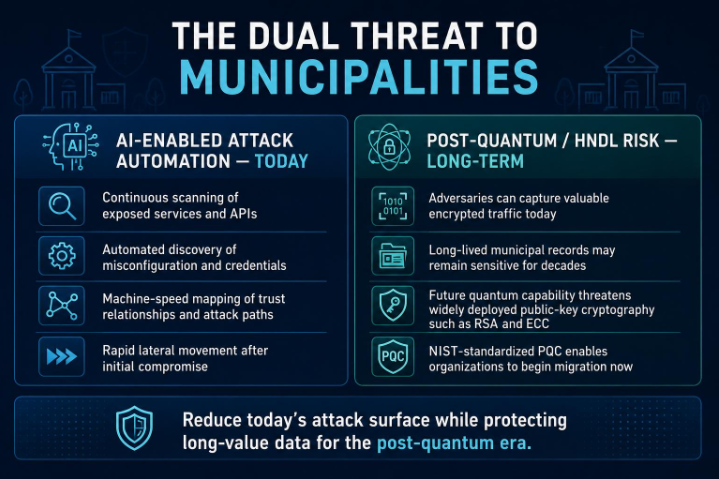
3. The Dual Threat: AI-Enabled Attack Automation + Post-Quantum Risk
Municipalities face two converging security challenges: immediate machine-speed attack automation and long-term quantum decryption threats.
3.1 AI-Enabled Cyber Operations
AI does not create every cyber vulnerability, but it can dramatically increase the speed and scale at which existing weaknesses are discovered and exploited.
AI-assisted attackers can:
- continuously scan exposed services and APIs
- discover configuration weaknesses
- automate credential attacks
- map trust relationships
- identify reachable systems
- adapt attack paths
- accelerate lateral movement following an initial compromise
Complex environments containing many interconnected security products, identity systems, remote-access pathways, cloud interfaces, and endpoint agents can create a large attack surface for automated reconnaissance.
The defensive objective is therefore not simply to make each software component marginally harder to attack.
It is to reduce the number of paths an attacker can use and place hard cryptographic boundaries between critical systems.
3.2 Harvest Now, Decrypt Later
Sensitive municipal information can remain valuable for many years.
Examples include:
- citizen PII
- infrastructure plans
- law-enforcement information
- land and property records
- emergency-management information
- utility and operational data
An adversary can capture encrypted traffic today and retain it for attempted decryption in the future.
NIST has standardized post-quantum algorithms specifically to support migration toward cryptographic systems designed to resist future quantum attacks.
Municipalities therefore have an opportunity to begin protecting long-value communications now rather than waiting for cryptographically relevant quantum computers to arrive.
4. Architectural Requirements for Municipal Resilience
To achieve true operational resilience without overwhelming municipal budgets, local governments require an architecture built around eight core criteria:
| Requirement | Municipal Objective |
|---|---|
| Cryptographic Segmentation | Establish immutable, hardware-enforced boundaries between administrative IT, 911 CAD, water SCADA, and vendor paths. |
| Hardware-Anchored Trust | Anchor security decisions in physical hardware modules rather than software agents installed on endpoints. |
| Transport Independence | Secure communications uniformly across fiber, Ethernet, cellular (4G/5G), public Wi-Fi, satellite, or commercial internet. |
| Sovereign Control | Ensure the municipality maintains exclusive ownership of cryptographic keys, policy enforcement, and operational data. |
| Minimal Rip-and-Replace | Preserve existing investments in firewalls, EDR agents, IAM platforms, and network infrastructure (e.g., Cisco, Palo Alto, Microsoft, CrowdStrike). |
| Post-Quantum Readiness | Embed NIST-standardized PQC mechanisms into communications pathways supporting long-value data. |
| Operational Simplicity | Designed for small municipal IT/cybersecurity teams to manage without requiring a 24/7 Security Operations Center (SOC) expansion. |
| Mobile Security | Seamlessly extend zero-trust cryptographic protections to field technicians, emergency responders, and leadership. |
5. The iBlades Secure Communications Architecture
The iBlades.ai platform delivers an inline, hardware-anchored security architecture composed of three integrated components:
5.1 NetTron™
NetTron™ provides the policy-controlled secure communications fabric connecting approved users, systems, sites, and security zones.
Its role is to make the underlying network a transport mechanism rather than the basis of trust.
A simplified model is:
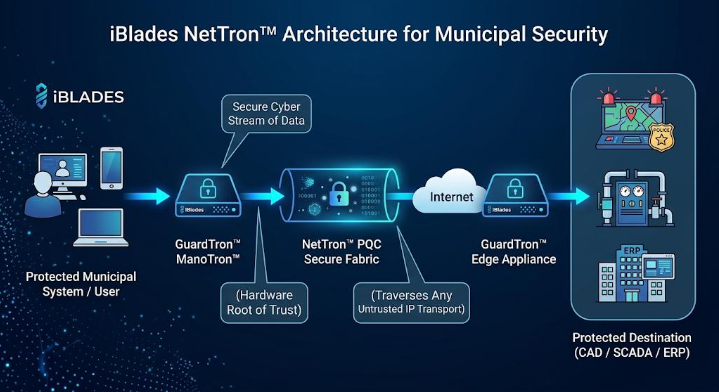
The transport moves the packets.
NetTron™ provides the trusted communications fabric.
5.2 GuardTron™
GuardTron™ is an inline hardware edge appliance positioned directly in front of critical municipal systems. Key municipal deployment locations include:
- City Hall administrative network perimeters
- 911 Public Safety Answering Points (PSAP) and CAD servers
- Water treatment facilities, pump stations, and SCADA control centers
- Third-party vendor remote-access gateways
- Remote public works facilities and municipal field offices
GuardTron™ enforces strict, unidirectional or bidirectional policy-bound tunnels that shield endpoints from direct network exposure and automated port scanning.
5.3 GuardTron™
GuardTron™ extends hardware-anchored security to mobile field operations. It provides tactical, PQC-secured voice, data, and video communications for police/fire leadership, emergency managers, field inspectors, and utility technicians working over commercial cellular or public Wi-Fi networks.
Potential municipal users include:
- police and fire leadership
- emergency managers
- field inspectors
- utility personnel
- municipal executives
- incident-response teams
The objective is to allow secure communications to continue even when the user must traverse commercial or otherwise untrusted communications infrastructure.
6. AI-Resilient Security Through Attack-Surface Reduction
The iBlades approach does not claim that AI attacks can be eliminated. Rather than attempting to detect every AI-generated malware variant, the iBlades architecture neutralizes attacks by eliminating available movement paths.
- Preventing AI Lateral Movement: When an administrative workstation is compromised via phishing, AI scripts attempt to scan local subnets for reachable CAD or SCADA systems. GuardTron™ and NetTron™ enforce cryptographic isolation at the hardware layer. Gaining access to the administrative network provides zero network visibility or path into public safety or utility zones.
- Eliminating API & Service Exposure: Automated bots continuously probe exposed web portals and management interfaces. Placing sensitive municipal databases behind GuardTron™ nodes removes these interfaces from public internet visibility entirely.
- Mitigating Credential Abuse: Stolen administrative credentials cannot be used to access protected systems unless the connection originates through an authenticated, hardware-bound GuardTron™ or GuardTron™ endpoint.
7. Municipal IT/OT Segmentation Example
The diagram below outlines a standardized, multi-zone cryptographic segmentation blueprint suitable for small, medium, and large municipalities:
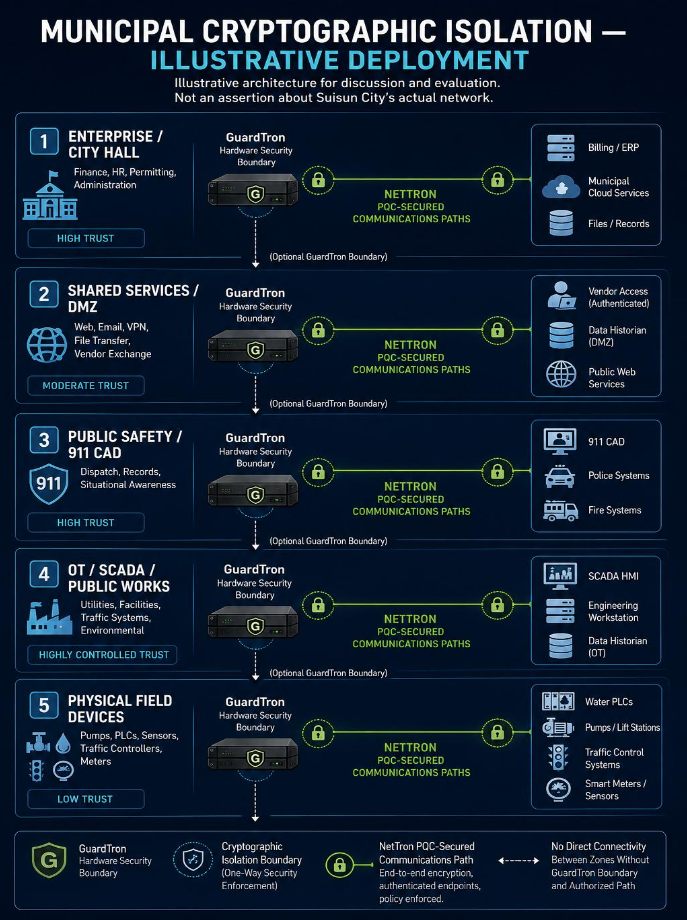
A municipal deployment could establish separate cryptographic trust zones for:
| Administrative / Enterprise IT |
|---|
| • City Hall workstations • finance • water billing • permitting • ERP • Microsoft/cloud services |
| Municipal DMZ / Shared Services |
|---|
| • historian systems • controlled vendor access • backup CAD services • approved data-exchange systems |
| Public Safety |
|---|
| • 911 CAD • police dispatch • fire dispatch • emergency management |
| OT / Public Works |
|---|
| • SCADA HMI • water-treatment PLCs • pump/lift stations • traffic controllers • telemetry systems |
| Mobile / Field |
|---|
| • police • fire • utility crews • inspectors • executives • emergency-response teams |
GuardTron™ boundaries can be placed between these environments so that compromise of one zone does not automatically create unrestricted lateral access to another.
8. Preserving Existing Infrastructure: No "Rip-and-Replace"
A primary barrier to municipal cybersecurity upgrades is the high cost and disruption of replacing legacy systems.
A central design objective of NetTron™ is evolution rather than replacement.
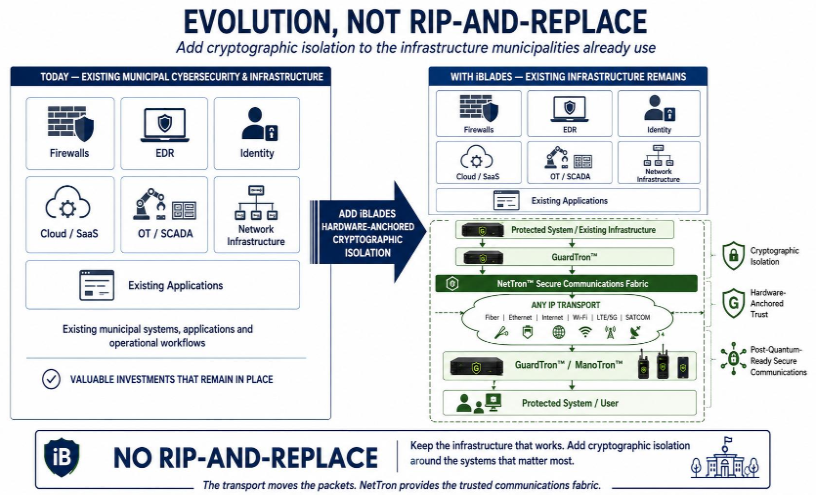
Municipalities already have substantial investments in:
- firewalls
- EDR
- identity systems
- cloud services
- VPNs
- network infrastructure
- OT equipment
- mobile applications
- cybersecurity monitoring
Those systems can continue performing their existing functions.
NetTron™ adds an additional hardware-anchored and cryptographically controlled communications fabric around the critical pathways that require stronger isolation.
This allows a municipality to begin with its highest-value or highest-risk systems rather than undertaking an enterprise-wide redesign.
9. Representative Municipal Evaluation Use Cases
Municipalities can deploy iBlades incrementally, prioritizing high-risk operational areas first:
Use Case 1 — Public Safety and 911 dispatch Isolation
Establish a GuardTron™-protected boundary around selected 911/CAD infrastructure and validate that compromise of an administrative test network cannot traverse into the protected environment.
Use Case 2 — Water Treatment & SCADA Protection
Protect a selected telemetry or SCADA communications path using GuardTron™ and NetTron™ while preserving the existing operational equipment and protocols.
Use Case 3 — Controlled 3rd Party Vendor Access
Replace broad network reach with an explicitly authorized cryptographic pathway to a defined maintenance system or service.
Use Case 4 — Secure Emergency Leadership and Field Communications
Equip city executives, police chiefs, and disaster response teams with ManoTron™ mobile devices for resilient communication during grid or network outages.
Use Case 5 — Multi-Site Municipal Secure Fabric
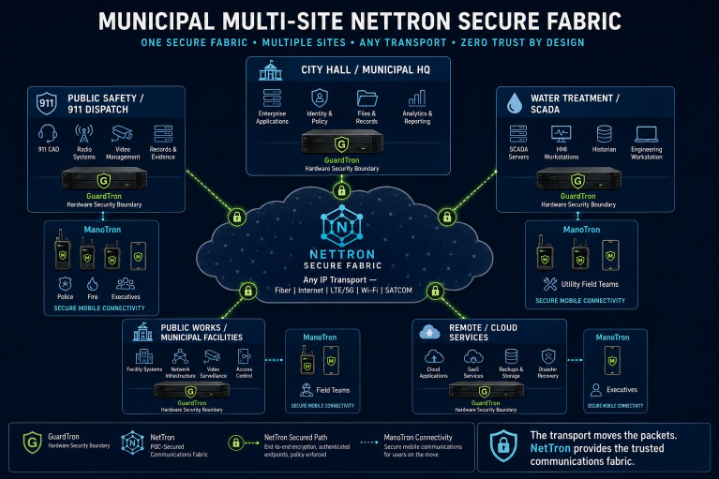
Establish NetTron™ connections among selected municipal facilities while allowing the underlying WAN or Internet service to remain transport rather than trust.
10. Proposed Proof of Concept
A structured PoC deployment allows city leadership to validate performance and security gains before full deployment:
Phase 1 — Architecture Alignment
Work with municipal IT/public-safety stakeholders to identify one or two controlled use cases.
Potential candidates:
- 911/CAD isolation
- SCADA/water telemetry
- controlled vendor access
- secure multi-site communications
Phase 2 — Controlled Inline Deployment
Deploy evaluation GuardTron™ nodes and establish the NetTron™ secure fabric in a controlled environment.
Validate interoperability with existing municipal systems.
Phase 3 — Security and Failover Validation
Test agreed scenarios including:
- attempted lateral movement
- unauthorized path discovery
- permitted versus denied communications
- failover behavior
- secure communications across available transports
Phase 4 — Operational Evaluation
Evaluate:
- security improvement
- operational burden
- performance
- interoperability
- manageability
- deployment effort
Phase 5 — Phased Production Expansion Decision
Establish an incremental rollout plan based on city priorities and available state/federal grant funding (e.g., CISA critical infrastructure grants).
11. Illustrative Success Criteria
Example success criteria could include:
| Evaluation Metric | Target Success Criteria |
|---|---|
| Verified Cryptographic Isolation | Simulated breaches in administrative IT cannot reach public safety or utility subnets. |
| Operational Continuity | Zero disruption to legacy applications, billing workflows, or emergency dispatch operations. |
| Transport Independence | Secure communications fail over seamlessly across fiber, LTE/5G, and satellite without session drop. |
| Minimal Administrative Overhead | Existing municipal IT staff can manage policies without requiring additional 24/7 staffing. |
| Post-Quantum Validation | Data streams successfully utilize NIST-standardized PQC encryption algorithms. |
| Controlled failover | Redundant NetTron™ infrastructure and configured alternate paths operate according to the agreed resiliency policy. |
12. Strategic Outcome
The objective is not to add another cybersecurity product to an already complex municipal environment. It is to determine whether critical municipal communications can be made:
- simpler
- more isolated
- transport independent
- hardware anchored
- AI-threat resilient
- post-quantum ready
- easier to operate
while preserving the municipality's existing infrastructure wherever practical.
The transition model is:
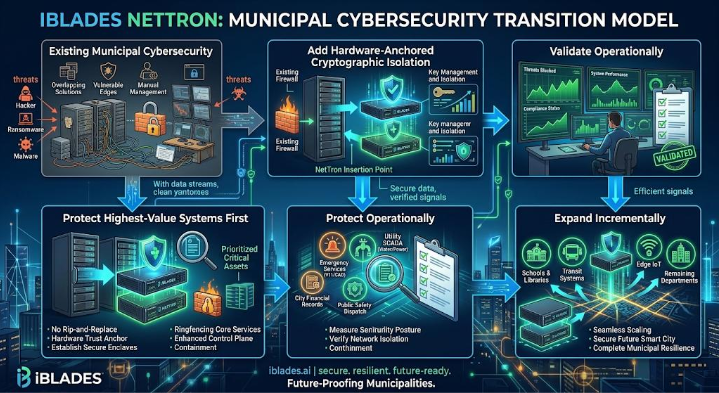
This approach allows municipalities to begin improving resilience without waiting for a complete network replacement or a large increase in cybersecurity staffing.
Disclaimer
This white paper is provided for educational and strategic evaluation purposes. Reference to broader municipal cyber incidents is included to illustrate real-world operational challenges. Technical designs, cryptographic configurations, and operational workflows must be validated with specific municipal technical, public safety, and legal stakeholders prior to deployment.
Architectural diagrams and deployment models are illustrative.
Final technical designs, cryptographic configurations, certification requirements, security controls, and operational workflows must be validated with the applicable customer technical, cybersecurity, public-safety, legal, and regulatory organizations.